Tuesday, 16 April 2013

THE MATHEMATICS SYMPOSIUM - I 2012

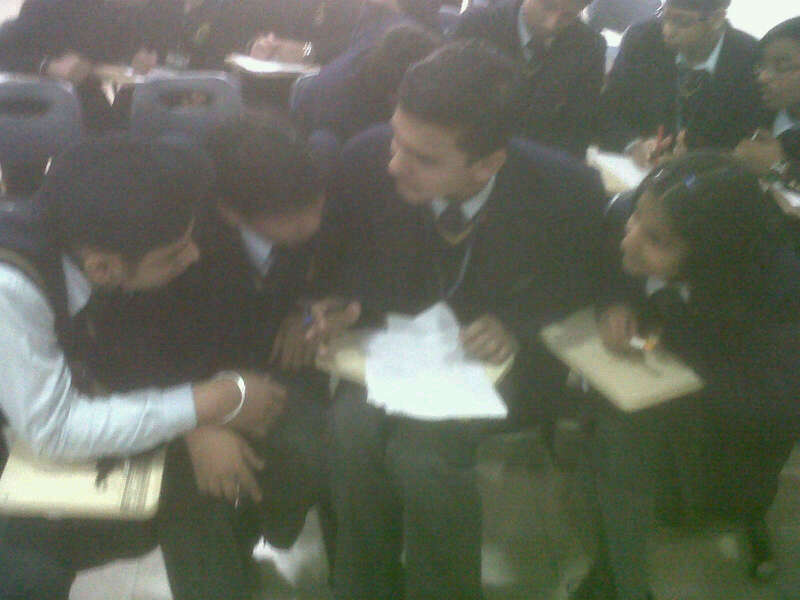
The year 2012 was decleared National Mathematical Year in honor of Mathematician Srinivasa Ramanujan's 125th birth anniversary. To celebrate the event, Varun Goel and Yuvraj, students of Grade 11 of Spring Dale Senior School, Amritsar, organised a Mathematical Symposium to gather children passionate about Mathematics. 
Varun explaining a problem


Yuvraj explaining a problem 
The event was held on 21st December 2012 and was a success, with students debating and discussing interesting Mathematical problems. There were around 35 participants from class 9th to 11th. The event was attended by 4 Maths teachers from the school.
Some students having fun

The teachers 


Following was a quiz prepared by Varun and Yuvraj, and the students solved it and had a discussion:


Q1.  What is the total number of possible starting moves in a game of chess for both the players?


Q2.  1, 4, 9, 7, _ ? Find the missing number


Q3.  A painter has been assigned a job of painting the square tiles of the external boundary of a 16 X 16 floor. If side of each tile is 4 inches, then how much paint does he need if one tile needs 200 mL paint. (Give your answer in liters.)


Q4.  8+13 = 89+?   [HINT:  6, 9,2,15,14,1,3,3,9 (DECODE TO   GET THE MATHEMATICIANS NAME)]


Q5. A polygon has 54 diagonals. How many sides does this polygon have?  


There was also a discussion about the famous Monty Hall Problem...........Now, the next Mathematics Symposium will be held on 15th May 2013!


Monday, 25 March 2013

Paul Erdős- Mathematician Extraordinaire

'If numbers aren't beautiful, I don't know what is.'

Paul Erdős, one of the greatest mathematicians to have graced the world would have completed a 100 years today had he been alive. In stature and number of mathematical papers published, he is comparable only to the legendary Leonhard Euler. Paul Erdős has written 1525 papers in his lifetime! Unlike other mathematicians, all his papers weren't authored by him; most of them were coauthored, he viewed and practiced Math as a social activity, for the betterment of the society.

It is safe to assume that he was a child prodigy, at the age of four, he could calculate, in his head the number of seconds a person had lived, given their age! Born to high school Mathematics teachers, Paul Erdős was always surrounded by beautiful Mathematical stuff. At 16, his father introduced him to Infinite Series and Set Theory, subjects that later went on to become his favorite. In 1934, when he was just 21 years old he was awarded a doctorate in Mathematics.

Paul Erdős had the eccentric personality that most geniuses of this stature are famous for. Worldly possessions meant nothing to him, and most of his rewards and earnings were donated to the needy. Although he was an atheist, he had a strange belief about 'THE BOOK', a book in which GOD (or Supreme Fascist as Paul Erdős referred to him) kept the best and most beautiful Mathematical proofs to himself! He spent most of his life as a wanderer, roaming around in search of the Truth; the Mathematical Truth. He would often show up at a colleague's house without informing them, and say, "My brain is open", indicating that he was ready to write a Mathematical proof along with the colleague. He would spend a week in their house before shifting to another house. Another one of his famous quote referring to this habit of his- 'Another roof, another proof'

Because he had worked with close to 511 people on Mathematical papers, his friends created the Erdős number as a humorous tribute to him. The Erdős number basically describes the closeness of a person to Paul Erdős. So, Erdős had a number 0, his closest collaborators had a number 1. See the list - LIST of people by Erdos Number


Ultimately it can be said, that Paul Erdős was more than what his achievements tell us. He was a genius, no doubt but it was his passion for Mathematics, the quest for the truth that truly defined him. He wanted the make the world a better place by spreading the beauty of Math, and we at Mathemating with Numbers salute this great personality on his 101st birthday.


Another one of his quotes!


Thursday, 14 March 2013

Pi day celebrations!!

  It is irrational, transcendental and highly enigmatic. Yet, we all love it and can't possible imagine our lives without, The oh so adorable Pi! And today all of us Math lovers are celebrating Pi day...

While the origins of Pi have been subject to a lot of speculation, it is thought that Pi was first used actually by the people who built the Great Pyramid at Giza. The reason behind this belief is that these pyramids were built with a perimeter of 1760 cubits and a height of 280 cubits the ratio of which approximates to 6.2857 which is equal to 2 times the value of Pi. However the symbol of Pi which we most commonly use is said to have been first used by mathematician William Jones in 1706. But what is exactly Pi? Pi is the ratio of a circle's circumference and diameter.

Over the years, many people have tried to give their own versions of Pi; using infinite series,continued fractions, polygon approximations and many more unique methods. Check them out:

Besides finding massive use in geometry, calculus and almost every known field to man, Pi has also made appearances in very special Mathematical problems that have actually the changed the way the world thinks about Math- 
Basel problem- This particular problem was solved by Leonhard Euler

The charm of Pi lies in its enigma, its mystery, no one knows where it will end. Because of this annually, people compete to find the most accurate value of Pi and see who can remember most digits of Pi

Here are some other cool Pi facts we think you would like-

1. The first 144 digits of pi add up to 666 (which many scholars say is “the mark of the Beast”). And 144 = (6+6) x (6+6)

2. In the Greek alphabet, π (piwas) is the sixteenth letter. In the English alphabet, p is also the sixteenth letter.

3. Pi Day” is celebrated on March 14 (which was chosen because it resembles 3.14). The official celebration begins at 1:59 p.m., to make an appropriate 3.14159 when combined with the date. Albert Einstein was born on Pi Day (3/14/1879) in Ulm Wurttemberg, Germany.

4. A Web site titled “The Pi-Search Page” finds a person’s birthday and other well known numbers in the digits of pi

5. The Pi memory champion is Hiroyoki Gotu, who memorized an amazing 42,000 digits.

6. Taking the first 6,000,000,000 decimal places of Pi, this is the distribution:
0 occurs 599,963,005 times,
1 occurs 600,033,260 times,
2 occurs 599,999,169 times,
3 occurs 600,000,243 times,
4 occurs 599,957,439 times,
5 occurs 600,017,176 times,
6 occurs 600,016,588 times,
7 occurs 600,009,044 times,
8 occurs 599,987,038 times,
9 occurs 600,017,038 times.


7. Computing pi is a stress test for a computer—a kind of “digital cardiogram.n the Star Trek episode “Wolf in the Fold,” Spock foils the evil computer by commanding it to “compute to last digit the value of pi.

8. The earliest known official or large-scale celebration of Pi Day was organized by Larry Shaw in 1988 at the San Francisco Exploratorium, where Shaw worked as a physicist, with staff and public marching around one of its circular spaces, then consuming fruit pies. The Exploratorium continues to hold Pi Day celebrations.


HAPPY Pi DAY fellow MATH LOVERS !


Sunday, 24 February 2013

MULTINOMIAL EXPANSION TUTORIAL


Hello readers, we have recorded our first tutorial video and you can check it out on YouTube :


We hope you guys like it. Feel free to leave your valuable remarks and suggestion in the comment box below.

PS- To check out more tutorials (non Math), check out our friend's blog : LINK

KEEP ON MATHEMATING!!

Wednesday, 13 February 2013

DIGITAL ROOT- ADD EM' UP!!


The concept of digital root is one of the most neat and easy concept in Mathematics. It helps explain many problems and further exemplifies the beauty of Math.

Digital Root of any number is the smallest single digit number that one obtains upon adding all the numbers present in a number. The digital root of 39, for instance is 3+9=12=1+2=3.

Digital Root showcases the beauty of Mathematics because the numbers of all the major sequences and series, like squares, cubes, Fibonacci series et al show a repetitive pattern in their digital root:                      

SQUARES
SQUARE
DIGITAL ROOT
 1
1
4
4
9
9
16
7
25
7
36
9
49
4
64
1
81
9
100
1
121
4
144
9
169
7
               
If one observes closely, the digital root starts showing a repetition after 9, i.e. a set of 9 consecutive square numbers shows this repetitive pattern. So, the next set showing this pattern will be from 10-18, then 19-28 and so on...

CUBES
CUBE
DIGITAL ROOT
 1
1
8
8
27
9
64
1
125
8
216
9
343
1
512
8
729
9
1000
1
1331
8
1728
9
Cubes follow an even shorter pattern; a set of only 3 consecutive cubes i.e. 1-3, 4-6 and so on...   

INTERESTING FACTS
·     
  •     If you are careful enough, you might have seen that if 9 is added to any number ‘n’, the digital root of the sum will be equal to digit root of ‘n’. In simpler words, the addition of 9 to a number doesn't produce a change in the digital root.

  •     The above fact helps us locate a multiple of 9. So if someone asks you for a multiple of 9 closest to the number 37218, simply obtain the digital root of 37218 (3) and then you have two options, you can either add 6 to get 9, or subtract 3 from the number; but because we are concerned with the closest number, we must subtract 3, which gives us 37215 whose digital root is 9, hence proving that it is a multiple of 9. This particular method is very useful in larger numbers

·       FUN FACT- 
      After lots of adding up and messy calculations, we both found out that 14 or FOURTEEN is the first number whose digital root is equal to the digital root of the numerical values of the alphabets of its spellings!!! They both equal 5!

We encourage our readers to perform their own operations and share any observations with the Mathematics world via our blog!!


Sunday, 13 January 2013

SOLUTION TO STAIRWAY TO HEAVEN


Here is the solution to our riddle ‘STAIRWAY TO HEAVEN’.

STAIRWAY TO HEAVEN’ is our adaption of the notoriously famous MONTY HALL PROBLEM. But, in that there is no devil; only a timid game show host. There are two goats and a car in the original problem.

The simple answer is that the man should switch. Switching would actually increase the probability of the new door by 33%, thus raising it to 66%.
The video below will give an intuitive explanation of the problem, so do watch it.


However, it must be noted that this is a case of probability, switching doesn't necessarily translate into winning. There is still a 33% chance that the door you have selected has the prize. Switching only decreases the odds of losing, not eliminate them!!


Sunday, 6 January 2013

'STAIRWAY TO HEAVEN'- A Mathematics riddle!

STAIRWAY TO HEAVEN is our adaption of a famous mathematics problem.

Suppose there is a man who just passed away (died!), and accidentally he has been sent to ‘hell’. There, he meets a sadistic devil who gives him a chance of escaping hell in order to go to ‘heaven’.

 But there is a catch, the person must choose a specific door which holds the ‘STAIRWAY TO HEAVEN’.

He presents the problem to the man:
There are 3 doors, two contain ultimate demolition and the last door holds the STAIRWAY. You must choose the door containing the stairway in order to escape.

The man eventually chooses a door, unaware of what it holds.
The devil who knows what is behind each door opens a door that doesn’t hold the STAIRWAY.

After revealing this door, he offers the man a choice: He can either stay on the door he has chosen or switch to the door that is now left.
So, considering the fact that the devil doesn’t want the man to go to heaven, the question arises; SHOULD THE MAN MAKE THE SWITCH OR STAY ON THE DOOR THAT HE HAS CHOSEN??

KINDLY TYPE IN YOUR ANSWERS OR VIEWS IN THE COMMENT BOX BELOW (please give mathematical explanation to you answers), the solution will be revealed next week, so stay tuned!!!